
Full-Truckload (FTL) and Less-than-Truckload (LTL) transport – how do they differ?
FTL or LTL? Find out how full-truckload shipping differs from less-than-truckload shipping, what factors influence the price, and when it’s worth booking a full truck.
Three pallets to Germany or a full truckload of raw materials to a manufacturing plant? Although both orders involve road transport, their organization and costs can vary significantly. In the first case, less-than-truckload (LTL) shipping is often sufficient; in the second, full-truckload (FTL) shipping may be the better option.
The difference between FTL and LTL starts with how much space the cargo requires in the truck and how it is to be delivered. Choosing the right service affects the freight rate, delivery time, and how the goods are handled. When does it make sense to book an entire truck, and when is it better to use less-than-truckload (LTL) shipping?
FTL – what is it, and when should you choose Full Truckload Shipping?
FTL (Full Truckload) refers to full truckload shipping, where a truck is dedicated to a single shipment. The goods are not consolidated with shipments from other customers, and the vehicle typically travels directly from the loading location to the recipient.
However, this does not mean that the trailer must be completely full. A company can also order FTL transport for a smaller shipment if it needs a customized delivery schedule, wants to minimize transshipments, or requires transport that demands special care.
With FTL, it is easier to align loading and delivery with warehouse operations. There is no need to wait for shipments from other shippers to be consolidated, and the route can be planned specifically for a given order. Fewer transshipment operations also mean fewer opportunities for goods to be damaged during handling.
Full-truckload transport is often used by manufacturing companies and distributors transporting larger batches of raw materials, food products, or industrial materials. FTL also works well for regular deliveries between warehouses and shipments where it is important to precisely set the pickup date.
However, it’s important to keep costs in mind. When booking a dedicated vehicle, the customer pays for its use even if part of the cargo space remains empty. For small orders, this isn’t always economically justified.
LTL – what is it and how does Less-than-Truckload shipping work?
LTL (Less Than Truckload) is a partial-load shipping service in which a single customer’s cargo occupies only part of the vehicle’s space. The remaining space can be used to transport shipments from other shippers.
Suppose a company needs to deliver four pallets of products to a business partner. Instead of booking an entire truck, it can use partial-load shipping and combine its cargo with other shipments heading in a similar direction. This way, the delivery cost does not have to cover the exclusive use of the entire vehicle.
In the logistics industry, the term LTL is often used in reference to less-than-truckload shipping, although the way such a service is organized may vary. In traditional network groupage, also known as groupage, shipments pass through terminals where they are sorted and consolidated according to delivery destinations. However, less-than-truckload transport can also take place without such transshipments, directly between pickup and delivery points.
Therefore, transit time is primarily influenced by the route and the number of operations along the way. LTL does not necessarily mean long wait times. On popular routes, regular service allows for efficient deliveries, although the flexibility to customize schedules is often more limited than with FTL.
FTL vs. LTL – key differences
The fundamental difference lies in vehicle utilization, but when choosing a transport method, the method of cost calculation, route planning, and cargo requirements also play a significant role.
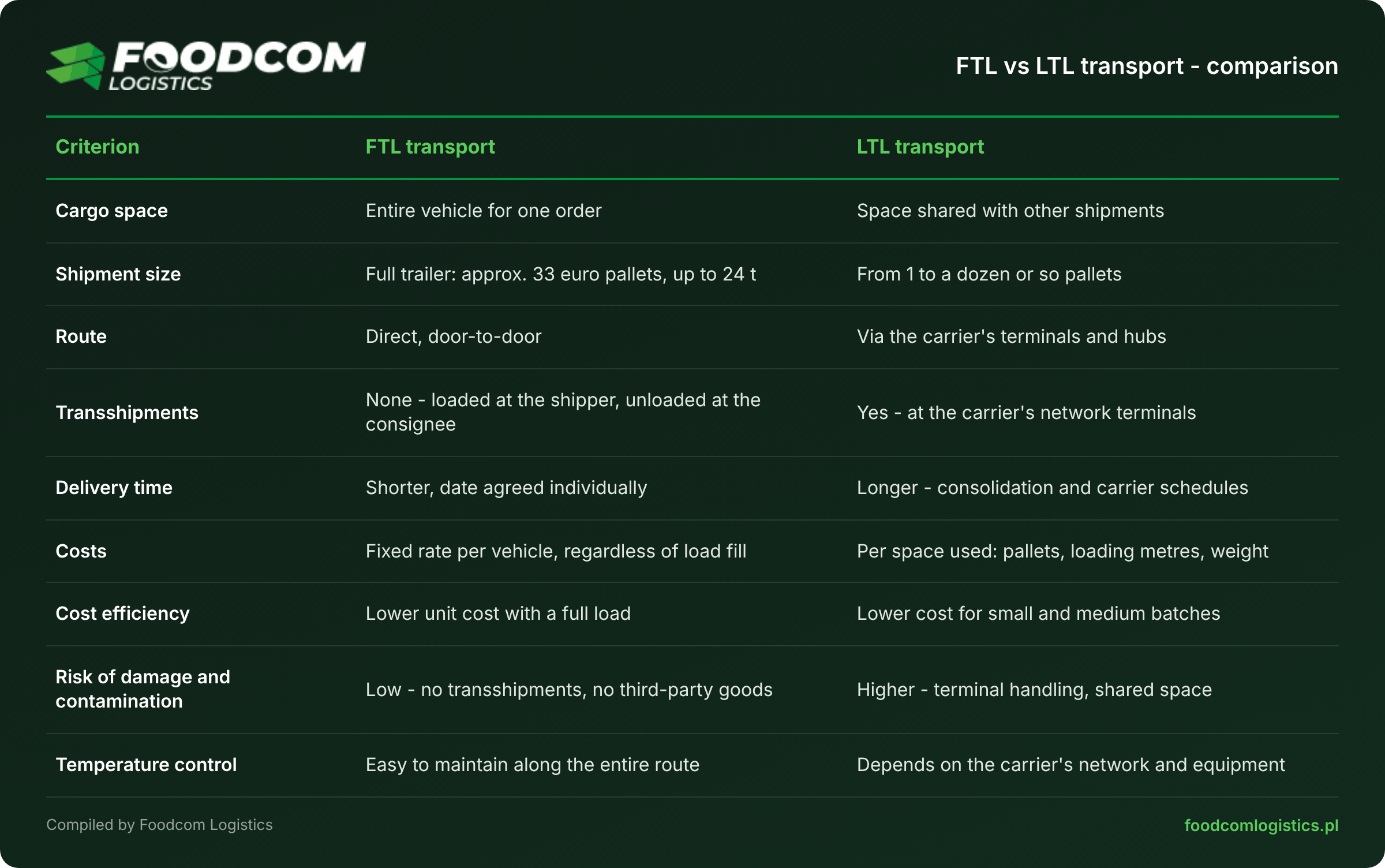
For a few pallets, LTL often saves money because you don’t have to pay for an entire truck. When the cargo takes up most of the trailer, the price difference may be much smaller. In such a situation, it’s worth comparing the costs of both solutions, especially if the goods need to be delivered directly to the recipient.
How much do FTL and LTL shipments cost?
There is no single rate for full-truckload (FTL) transport, nor is there a universal LTL price list. The price depends on the route, the type of cargo, vehicle availability, and the terms of the shipment.
For FTL, the calculation is most often based on the cost of providing a truck for a specific route. The carrier takes into account the distance, vehicle type, tolls, and the time required to complete the shipment. Additional requirements, such as temperature-controlled transport, can affect the quote.
For LTL, the parameters of the shipment itself are more important. What matters is its weight, volume, number of pallets, and the amount of space it occupies in the vehicle. It is also important whether the goods can be stacked and transported together with other products.
A good example is three standard Euro-pallets and three non-standard-height pallets that cannot be stacked on top of one another. Although the number of cargo units is the same, the second shipment may take up more usable space and therefore cost more.
When comparing quotes, it’s also worth checking the scope of service. If the goods are needed to start production, savings on freight may become irrelevant in the event of a delayed delivery.
When to choose FTL and when to choose LTL? Practical examples
The easiest way to understand the differences is by looking at specific orders. The number of pallets alone does not determine the choice of transport. Equally important are the weight of the goods and the deadline by which the shipment must reach the recipient.
Three pallets of food products to Germany
A Polish distributor has prepared three pallets of products for a business partner in Germany. The goods do not require special shipping conditions, and the recipient accepts a standard delivery time.
In this situation, it’s worth checking LTL shipping first. The cargo takes up only a small portion of the truck’s space, so it can be consolidated with other shipments. Booking an entire truck just for three pallets could unnecessarily increase the cost of transportation.
24 pallets of raw materials to a production plant
A manufacturer orders 24 pallets of raw materials, which must arrive at the factory before the start of the next production cycle. The delivery must take place by the agreed-upon deadline, and additional transshipments are undesirable.
In this case, FTL may be a good solution. A dedicated truck allows for planning direct transport and coordinating the unloading time with the plant.
However, before placing an order, you must check the shipment’s weight and dimensions. Even if 24 pallets fit on the trailer, their combined weight may exceed the vehicle’s maximum allowable load. Therefore, the number of pallets alone is not sufficient to confirm that the entire order can be fulfilled by a single truck.
Regular Deliveries to Multiple Recipients
A trading company serves customers in Poland, the Czech Republic, and Germany. Some order a few pallets per month, while others receive larger batches of products.
With such varied orders, there’s no need to limit yourself to a single mode of transport. Smaller shipments can be handled via LTL, while larger ones can be sent directly as FTL. This way, the company doesn’t pay for unused space where it isn’t needed.
PTL (Partial Truck Load) – when is it an alternative?
Not every shipment fits the standard less-than-truckload (LTL) model, but not every shipment requires a full truckload either. For larger loads, you can consider PTL (Partial Truck Load).
PTL is often used to transport shipments that are too large or require too much specialized handling for a typical less-than-truckload network, but still do not fill an entire trailer. Depending on how the shipment is organized, this can mean fewer transshipments and a more direct route.
However, there is no single, fixed number of pallets at which LTL transitions to PTL. Freight carriers may define the scope of their services differently. Therefore, for larger shipments, it’s best to check the available options and compare their terms.
How do you prepare a quote request for FTL or LTL transport?
To receive an accurate quote, it’s not enough to simply state that you have a few pallets to ship. The carrier needs to know the total weight of the shipment, its dimensions, and where and when it is to be picked up.
In your inquiry, it’s a good idea to include the type of goods, the number and type of pallets, the total weight, the loading and unloading addresses, and the planned shipment date. If the product requires a specific temperature, special protection, or cannot be stacked, be sure to note this as well.
With this information, it is easier to determine whether a less-than-truckload (LTL) shipment will suffice or if a dedicated truck will be needed. For regular deliveries, it is helpful to specify their frequency and expected volumes right away. This can assist in planning shipments and comparing costs over the long term.
Similar rules apply to domestic and international transport. For international shipments, you must also consider route planning and requirements related to the delivery destination.
Frequently asked questions qbout FTL and LTL shipping
Is LTL always cheaper than FTL?
No. Less-than-truckload (LTL) shipping is often more cost-effective for small shipments, but as the number of pallets increases, this advantage may diminish. For larger loads, it’s worth comparing LTL and FTL prices for a specific route.
How many pallets can be transported via LTL?
There is no single universal limit. Carriers set their own terms for less-than-truckload shipments. In addition to the number of pallets, their weight, dimensions, and how they are arranged in the vehicle are also important factors.
Is FTL shipping faster than LTL?
FTL often makes it easier to arrange direct delivery, but it does not automatically guarantee a shorter transit time. The delivery time is also influenced by the length of the route, vehicle availability, and the agreed-upon schedule.
FTL or LTL – which transport option should you choose?
If a company is shipping a small shipment, less-than-truckload (LTL) transport often helps reduce costs. For larger shipments or deliveries requiring a customized schedule, FTL may be the better solution. It’s important to compare not only the price but also the terms of transport and the handling of the shipment.
Are you planning domestic or international transport? Contact Foodcom Logistics and submit information about your shipment. Based on this information, we’ll help you choose the right type of transport and prepare a customized quote.
Related articles
Domestic vs. international transportation – key differences.
Domestic and international transportation differ not only in terms of distance, but also in terms of costs, regulations, and delivery arrangements. Find out what to consider when planning the transport...

What factors determine the cost of international shipping?
The cost of international shipping can even vary depending on the day of the week. Learn about the factors that influence freight rates and find out how to optimize your...
